 Green Water Technology Co.,Ltd
Home
Library
Media
Jet Mixing Nozzle Full Analysis
Jet Mixing Nozzle Full Analysis
I. Overview of Enhancement Nozzles
Enhancing nozzles are key functional components in jet aeration and fluid mixing systems. Their function is not simply to eject fluid, but rather to further enhance the mixed flow after the initial gas-liquid mixing by the front-end jet injector, thereby improving the system's circulation capacity, mixing efficiency, and mass transfer efficiency.
In typical applications, the Venturi jet injector is responsible for creating negative pressure to draw in air, oxygen, or other media and completing the initial mixing; the enhancing nozzle then releases the mixed flow into the pool, container, or pipe in an optimized jet pattern, drawing in more surrounding liquid through diversion, entrainment, and turbulence enhancement. Because of its "secondary enhancement" role at the system's downstream end, the enhancing nozzle becomes a crucial component for improving overall operating efficiency.
II. Working Principle of Enhanced Nozzle
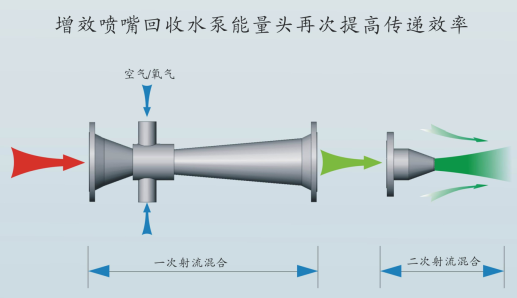
The working principle of the enhancement nozzle can be summarized as "primary mixing and secondary enhancement".
In the first stage, the mixing is completed by the front-end Venturi jet. After the motive water enters the jet, it forms a high-speed fluid in the jet chamber. As the flow velocity increases and the static pressure decreases, air, oxygen or other sucked-in media enter the main fluid and complete the primary gas-liquid mixing inside the jet.
In the second stage, secondary intensification is achieved by the enhancement nozzle. After primary mixing, the fluid is injected into the main liquid environment through the enhancement nozzle, where the nozzle structure and jet flow pattern create a stronger entrainment and diversion effect. According to existing local data, the enhancement nozzle can attract approximately 4 to 5 times the amount of surrounding liquid as the working fluid to participate in the mixing, thereby forming a larger-scale circulating flow field and a higher-intensity secondary mixing process.
From a fluid mechanism perspective, this process is consistent with the Venturi effect, Bernoulli's principle, and jet entrainment effect. After the fluid accelerates in the contraction section, a low-pressure zone is formed, which in turn draws surrounding fluid into the mixing and diffusion section, achieving flow amplification, enhanced circulation, and improved mass transfer. Therefore, the core value of the efficiency-enhancing nozzle lies not in "ejection," but in "driving more fluid to participate in mixing through jetting."
III. Main Advantages of Enhanced Nozzles
1. Improved Oxygen Utilization Efficiency.
Enhanced nozzles, through secondary jet intensification, allow the gas-liquid mixture to continue entrainment and turbulence after entering the main liquid phase. This helps expand the
contact range between oxygen and water, improving the efficiency of oxygen transitioning from the gas phase to the liquid phase. For wastewater biological treatment systems, this translates to higher oxygen utilization and a more
stable oxygen supply.
2. Energy Savings in the System.
The efficiency-enhancing nozzles themselves do not directly provide power, but they can make fuller use of existing kinetic water energy by optimizing the jet flow pattern and diversion capacity.
Under the same pump power conditions, if the system can achieve a larger circulation range, better mixing effect, and higher oxygen utilization rate, the overall operating energy efficiency will be improved.
3. Expand the area of mixing services.
Enhanced nozzles can drive a wider range of liquid flow during spraying, thereby expanding the actual service area of a single unit. For systems that need to maintain sludge suspension,
reduce sedimentation, and enhance circulation within the tank, this feature can significantly improve the overall flow field distribution.
4. Improve mixing uniformity.
By enhancing secondary mixing and circulation paths, the enhanced nozzles help improve the uniformity of dissolved oxygen distribution, sludge concentration, and overall liquid flow stability within
the tank. This advantage is particularly pronounced for aeration tanks, reaction tanks, or container systems where high mixing uniformity is required.
5. Easy to install and requires minimal maintenance.
Local data indicates that the N-series enhancement nozzles are characterized by easy installation and maintenance-free operation. As static fluid components, their structure
is relatively simple, without complex transmission mechanisms. Provided that the materials and operating conditions are properly matched, they typically have low maintenance requirements and high long-term operational stability.
6. Flexible layout, adaptable to renovation projects.
The enhanced nozzles can be flexibly arranged according to the pool type and are suitable for renovation scenarios without interrupting or draining water. This feature has
high engineering value for upgrading, expanding, and energy-saving retrofitting existing wastewater treatment facilities.
IV. Application Scenarios of Enhanced Performance Nozzles
1. Wastewater treatment aeration system
For equalization tanks, homogenization tanks, reaction tanks, and other liquid treatment systems that require strong circulation and anti-deposition capabilities, enhancement nozzles can
improve the overall mixing effect by expanding the spray range and strengthening the flow field distribution....
2. Tanks or containers requiring large-scale circulation and stirring
For equalization tanks, homogenization tanks, reaction tanks, and other liquid treatment systems that require strong circulation and anti-deposition capabilities,
enhancement nozzles can improve the overall mixing effect by expanding the spray range and strengthening the flow field distribution.
3. Old system efficiency improvement project
In existing systems, if there are problems such as insufficient oxygen supply, uneven mixing, weak circulation capacity, or limited modification window, efficiency-enhancing nozzles
are suitable as key reinforcement components in efficiency improvement and modification due to their convenient installation and flexible layout.
4. Working conditions requiring high mixing uniformity
Enhanced nozzles are also highly applicable in process scenarios requiring improved liquid uniformity, enhanced circulating turbulence, and prevention of localized sedimentation.
These needs are not limited to wastewater treatment but are also prevalent in other liquid mixing and circulation applications.
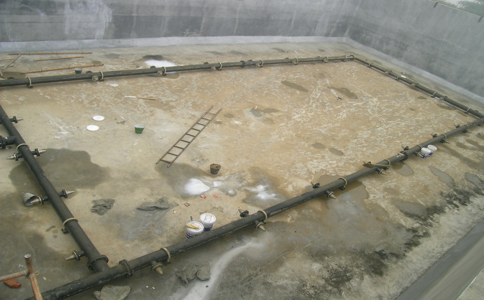
Project diagram:
V. Engineering Value of Enhanced Nozzles
From a system perspective, the efficiency-enhancing nozzle is not simply an end-flow component, but a crucial node that determines whether the mixed flow can fully release energy, form an effective cycle, and achieve efficient mass transfer after entering the main liquid.
Its engineering value is mainly reflected in the following aspects:
For jet aeration systems, if the front-end jet nozzle solves the problem of "drawing in and initially mixing," then the enhancement nozzle solves the problem of "how to efficiently release and amplify the mixing effect in the main liquid." Only by combining the two can the overall performance of the system be fully realized.
VI. Conclusion
The enhancement nozzle is a crucial functional component for improving the performance of a jet system. Its core function lies in enhancing oxygen utilization, improving mixing uniformity, expanding the mixing service area, and optimizing the overall system energy efficiency through secondary jet enhancement, entrainment, and circulation amplification. In engineering projects that prioritize aeration efficiency, mixing effect, operating energy consumption, and ease of modification, the enhancement nozzle should not be simply regarded as an ordinary accessory, but rather evaluated and configured as an important component for system performance optimization.
VII. Contact Information
Company Website: https://www.cd-greenwater.com
Technical Contact Number: 028-85130135
Customer Service Contact Number: 18515915124
Contact Email: jane1984@cd-greenwater.com
Address: No. 191, Section 1, Changcheng Road,
Xihanggang, Shuangliu District, Chengdu